
Objective movement, mobility, and strength testing provides teams with a clear, trackable trend line of an athlete’s physical recovery. By establishing baseline metrics and monitoring limb symmetry indexes, clinical and performance teams can transition from subjective guesswork to data-informed conversations—ensuring clear communication without replacing critical clinical judgment.
Why return-to-sport decisions are rarely simple
Return-to-sport is not a single moment. It is a judgment that has to weigh tissue healing, movement quality, strength capacity, the demands of the sport and the athlete’s own confidence at the same time. Contemporary return-to-play models treat it as a multifaceted, data-informed process rather than a fixed date on a calendar.
That is also why no single number should carry the decision. A clinical framework for return-to-sport decision-making notes that too few tests can hide part of the picture, while too many can add noise and drain staff time, and there is still no agreed-on “perfect” set of tests. The practical takeaway is to build a small, repeatable picture and compare it against the athlete’s own baseline.
Why subjective feedback is important but incomplete
Athlete feedback is valuable. How the knee feels, how confident a player is cutting at speed, how much soreness shows up the day after a session: these are real inputs, and ignoring them is a mistake.
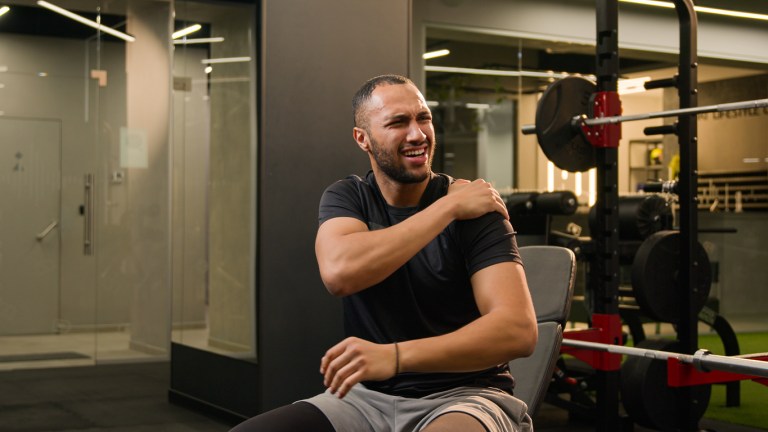
The catch is that subjective reports can be pulled in different directions. A systematic review of psychological readiness measures found that self-reported scores can be skewed by social desirability, overconfidence, or pressure to get back on the field. An athlete who badly wants to play may underreport symptoms, while an anxious one may overstate them. Subjective feedback tells you something important, but on its own it is hard to track consistently over time.
What movement and mobility testing can add
This is where consistent measurement earns its place. Tracking range of motion, balance, stability and side-to-side symmetry gives you something you can compare week to week instead of relying on memory or a one-off visual check.
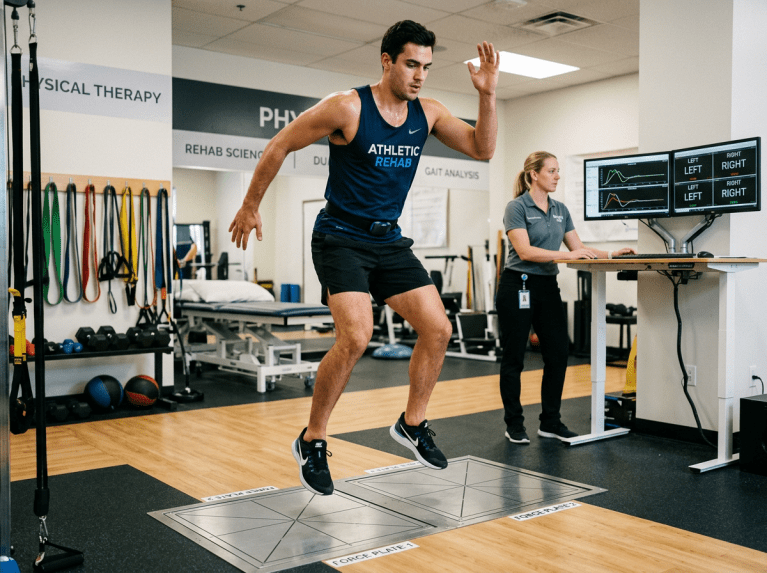
Consistent movement and mobility testing can help clinicians and coaches follow changes in range of motion, balance and stability over time, rather than leaning only on subjective impressions or a single observation. Repeatable movement and mobility testing also helps catch what the eye misses. Work on knee rehab shows athletes can reach symmetry on distance-based hop tests while still landing with poor mechanics, which is exactly why pairing the numbers with movement-quality screening matters.
Why strength testing matters during rehab
Strength is often the clearest signal of where rehab really is. Left-right comparisons, submaximal testing, strength endurance and steady progress tracking all give the team objective markers to work with. A common reference point in the literature is a limb symmetry index near 90 percent for strength and hop performance, though the exact cutoff varies and no single threshold settles the question.
Adding objective strength testing to the rehab process gives the athlete, clinician and coach a clearer shared language for discussing progress, training tolerance and readiness for more demanding sport-specific work. It turns “it feels stronger” into something the team can actually plot.
Moving toward dynamic testing in later stages
As athletes progress into later stages of rehab, jump and power testing can add another layer of information about lower-body power, reactivity and sport-specific readiness. This kind of data should support, not replace, clinical reasoning, athlete feedback and sport-specific assessment. It is also worth remembering that the link between hop and jump performance and reinjury risk is still not fully established, so these metrics are one input among several, not a clearance test on their own.
How objective data supports better conversations
The real value of testing is not the data itself, it is the conversation it makes possible. Clear trends help everyone see progress, set shared expectations and reduce guesswork. When a clinician, a coach and an athlete are looking at the same baseline and the same trend line, the discussion shifts from opinion toward evidence. Platforms such as Output Sports can help teams collect movement, mobility and strength data in a repeatable workflow, which makes those trends easier to track and talk through. The data should inform the decision. It does not make the decision.
How to use testing without overcomplicating rehab
Good testing fits into the work rather than getting in the way. A few principles keep it useful:
- Keep protocols consistent so numbers stay comparable.
- Test at appropriate stages, not constantly.
- Compare trends, not isolated results.
- Use simple reports the athlete can understand.
- Adapt the tests to the athlete and the sport.
- Combine the data with clinical judgment, every time.
What to avoid when using performance data in rehab
A few habits quietly undercut the value of objective testing:
- Overreacting to one poor test on a tired day.
- Reading numbers without context.
- Comparing athletes who are not really comparable.
- Treating a test result as a diagnosis.
- Assuming symmetry alone means readiness. Symmetry can mislead, partly because the uninvolved limb often weakens during recovery, so limb symmetry can overestimate true function.
- Letting any single metric make the return-to-sport call.
Where this leaves clinical and performance teams
Objective movement and strength testing will not decide when an athlete is ready, and it should not try to. What it can do is make rehab conversations clearer, more consistent and less reliant on guesswork, so the people responsible for the call are working from a shared, trackable picture. Used carefully alongside clinical reasoning and athlete feedback, that is a real upgrade to how teams talk about return-to-sport.
FAQ:
Q: Why shouldn’t limb symmetry index (LSI) be the only metric for return-to-sport clearance?
A: While achieving a limb symmetry index (LSI) near 90% is a common benchmark, it can occasionally overestimate true functional capacity. During an extended recovery period, the uninjured limb can suffer deconditioning and weaken. If the baseline reference point drops, the injured limb can look symmetrical on paper without being fully recovered or sport-ready.
Q: Can objective movement and strength testing replace a clinician’s judgment?
A: No, objective data does not replace clinical reasoning or athlete feedback. Instead, it offers a shared, measurable language for practitioners, coaches, and athletes to monitor progress over time, ensuring return-to-play choices are backed by data trends rather than guesswork.
Q: How does subjective athlete feedback skew return-to-play timelines?
A: Subjective reporting is vulnerable to psychological and situational biases. Highly motivated athletes may underreport residual pain or overstate psychological readiness due to external pressures to return to the field, whereas anxious athletes might overestimate symptoms out of fear of reinjury.
Sources
- Sports Medicine Update (AOSSM), “Return to Play After ACL Reconstruction: Integrating Key Metrics”
- “A Framework for Clinicians to Improve the Decision-Making Process in Return to Sport,” PMC
- “Return to Sport After ACL Reconstruction: Strength and Functionality Testing,” PMC
- “Limb Symmetry Indexes Can Overestimate Knee Function After Anterior Cruciate Ligament Injury,” Journal of Orthopaedic & Sports Physical Therapy
- “The utility of psychological readiness scales in predicting return to sport: a systematic review,” BMC Psychology