You do the same workout you were doing two years ago. But now you need an extra day to feel right again, your joints are more vocal about it, and the muscle soreness lingers longer than it used to. Nothing is injured. You’re just recovering differently. That is not a malfunction. That is the physiology of aging, and understanding it makes you a better athlete at any age.
Athletes over 50 can continue to perform at a high level by prioritizing recovery. Protein intake, sleep quality, training spacing, and recovery modalities become more important with age.
Recovery is where adaptation actually happens. The training session creates the stimulus. Everything that follows determines whether that stimulus translates into progress or just accumulated fatigue. After 50, the recovery side of that equation carries more weight than it did before, and it responds well to being taken seriously.
The Physiology Behind Slower Recovery
Several things change in the recovery process as you age. The anabolic response to exercise becomes blunted: the hormonal and cellular signals that trigger muscle repair and growth are less robust. Testosterone and growth hormone levels decline. Inflammation following training persists longer before resolving. And the efficiency of muscle protein synthesis, the process by which damaged fibers are rebuilt, decreases.
The practical result is that adults over 50 typically need more time between sessions targeting the same muscle groups. Ignoring it and training through inadequate recovery produces accumulated fatigue and injury risk, not faster progress. As training age increases, the variables surrounding training become proportionally more important. Nutrition, sleep, and recovery modalities are not optional extras. They are where the gains actually live.
Protein and the Anabolic Threshold
Muscle protein synthesis requires amino acids, and leucine specifically acts as the primary trigger for the signaling cascade that initiates the repair process. In younger adults, a moderate protein dose produces a strong anabolic response. In adults over 50, that threshold rises: a larger dose of higher-quality protein is needed to achieve the same effect. Researchers call this anabolic resistance.
High-quality protein sources become more important, not less, as you age. Whey protein powder is frequently used in aging research for exactly this reason: its leucine content and rapid absorption rate make it effective at maximally stimulating muscle protein synthesis even in populations where the anabolic response has diminished.
What the Research Confirms
A comprehensive review published in the Journal of the International Society of Sports Nutrition analyzed 49 randomized controlled trials involving over 1,800 participants and found that protein supplementation significantly augmented muscle mass and strength gains during resistance training. The effect size increased with age. Older populations benefited more from supplemental protein than younger ones, consistent with what we know about rising anabolic thresholds.
This directly supports the case for deliberate, structured protein intake as a recovery and adaptation tool in older athletes, not as a beginner supplement but as a precision nutrition strategy.
Sleep Is Not Negotiable
The majority of daily growth hormone output occurs during slow-wave sleep. Growth hormone drives tissue repair, collagen synthesis, and the anabolic environment that makes training adaptation possible. When sleep is insufficient or fragmented, that process is disrupted, and the training stimulus you worked for does not convert into the adaptation you expected.
Consistent sleep schedules, minimizing evening light exposure, cooler sleeping environments, and limiting alcohol are the interventions with the strongest evidence base for improving sleep quality. Adults over 50 are statistically more likely to experience disrupted sleep architecture, which makes these habits more important, not less.
Heat Therapy and Recovery
Regular sauna use improves peripheral blood flow to recovering muscle tissue, supports the clearance of metabolic waste, and induces heat shock proteins that protect muscle cells from further damage. Finnish cohort data links frequent sauna use to reduced rates of musculoskeletal pain and better self-reported physical function in older adults. Building in structured recovery sessions with traditional saunas is one of the more evidence-supported tools available for athletes managing the demands of training alongside the physiological realities of aging.
Building a Recovery-First Framework
The shift required after 50 is not training less. It is building the same rigor around recovery that you already bring to training itself:
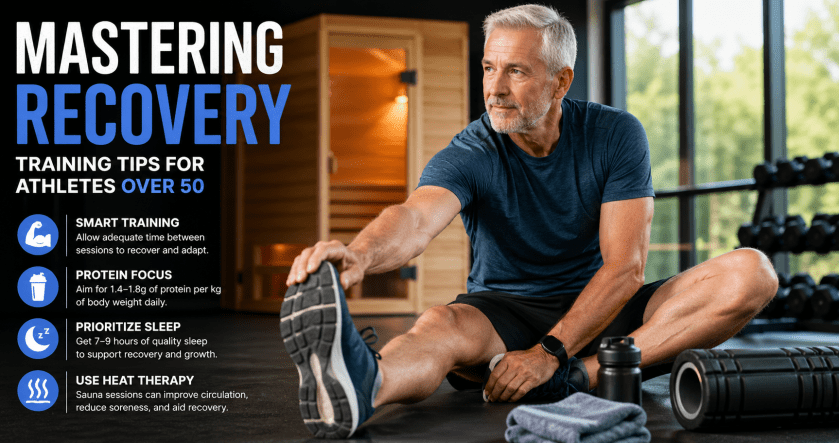
- 1.4 to 1.8 grams of protein per kilogram of body weight daily, with attention to post-training timing
- 48 to 72 hours between sessions targeting the same muscle groups
- 7 to 9 hours of quality sleep treated as a training variable, not a lifestyle variable
- Deliberate recovery modalities, including heat therapy, built into the weekly schedule
Progress does not slow because you train less as you age. It slows when the gap between training stimulus and recovery support widens. Close that gap, and the trajectory changes.
Frequently Asked Questions
Why do athletes recover slower after 50?
Hormonal changes, slower protein synthesis, and longer inflammation recovery can all contribute.
How much protein do athletes over 50 need?
Many active adults benefit from 1.4 to 1.8 grams per kilogram of body weight daily.
Can sauna help recovery after exercise?
Sauna may improve circulation, reduce soreness, and support recovery when used appropriately.