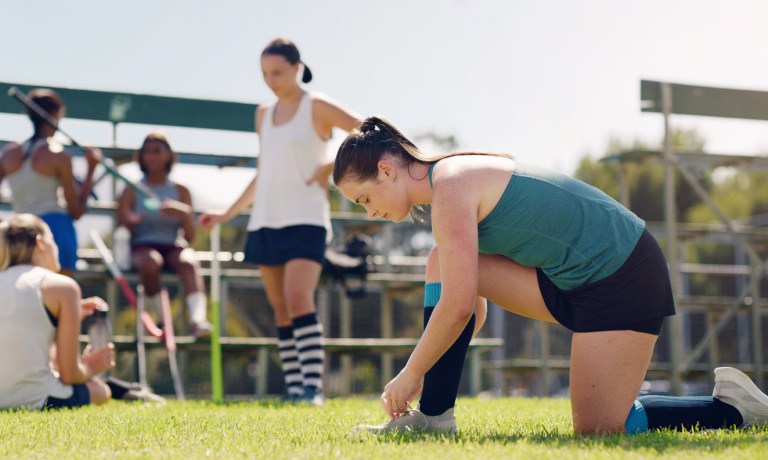
Every fall, thousands of college athletes show up to preseason convinced they’ve put in the work. Then week two hits, and it turns out the competition isn’t what gets them. It’s the training load. Overuse injuries have a way of creeping up fast in that first collegiate season, often before you even notice something’s off. Here’s why the jump from high school to college is hard on a student athlete’s body.
Why the High School to College Jump Is Biologically Different From Any Other Transition
Multi-sport high school athletes who become single-sport college specialists experience a training shift that the body has not encountered before: concentrated, high-volume loading in one movement pattern, applied to joints that may still have open growth plates or cartilage that has not reached full mechanical maturity. Published research co-authored by Dr. Cole and colleagues on cartilage injuries in young, high-demand athletes found that cartilage lesion prevalence in athletes averages 36 percent across studies, with a meaningful share of those athletes initially asymptomatic. The implication is that joint damage in young athletes accumulates before pain announces itself, which makes the first high-volume training semester a critical window.
What Happens to Overuse Injury Rates in the First Fall Semester
The spike in overuse injuries during the first college semester follows a predictable workload pattern. A freshman athlete moving from three to five high school practices per week to twice-daily college sessions, new strength and conditioning programs, and full preseason competition is absorbing a training stimulus that is categorically different in magnitude, even if the sport itself is familiar. This rapid escalation is the same mechanism that drives soft tissue injury rates in any population where workload increases faster than tissue can adapt. Tendons and cartilage adapt more slowly than cardiovascular fitness, which means an athlete can feel aerobically capable of sustaining the new training load while joint structures are still lagging behind in their adaptation.
Growth Plates and Cartilage Are Not Fully Protected by Strength
One of the more consequential misconceptions in young athlete development is that strength training protects joints in direct proportion to the muscle mass built. Skeletal maturity and cartilage mechanical properties develop on their own timeline, and a 17 or 18-year-old who is strong and fast may still have cartilage tissue that has not reached full adult resilience. Repetitive high-impact loading before that maturation is complete creates conditions where stress fractures, physeal injuries, and early cartilage damage are more likely than they would be in a 22-year-old with the same training volume. This is precisely what Dr. Cole has emphasized in his work on young athletes: the young athlete is not simply a smaller or lighter version of a professional, and the physiological differences are clinically meaningful when designing training programs.
What to Do in the Weeks Before Reporting
The weeks before a freshman athlete reports to campus are not a time to maximize fitness gains. They are a time to prepare joint structures for a sustained load that is about to increase substantially. Progressive loading in the specific movement patterns of the upcoming sport, rather than general conditioning, allows tendons and cartilage to begin adapting to the relevant stress. Posterior chain strengthening that supports the knee and hip under load, shoulder stability work for overhead athletes, and adequate sleep for tissue repair all contribute to a more resilient starting point. Avoiding a spike in training volume in the final two weeks before reporting is equally important, since arriving at camp already carrying microtissue fatigue from a last-minute fitness push is a reliable setup for the overuse injuries that follow.
How to Recognize Early Warning Signs Before They Become Structural Problems
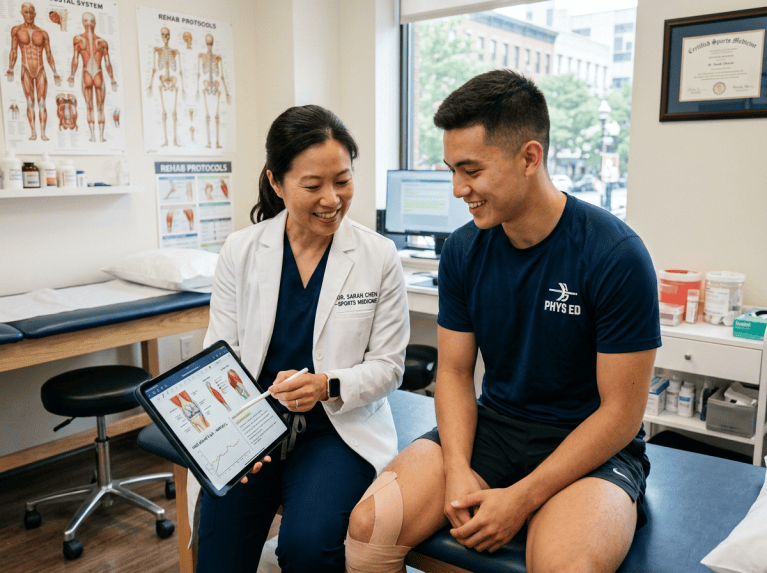
The signal that distinguishes manageable soreness from emerging joint damage in young athletes is not pain severity alone. It is pain that persists beyond 24 to 48 hours of recovery, worsens progressively over a training week rather than improving, or changes in character from the diffuse muscle soreness of hard work to a more localized, joint-specific discomfort. These patterns warrant evaluation rather than continued training through the symptom, since the cartilage and soft tissue injuries that begin as manageable early findings can become structural problems requiring more involved treatment if training continues unmodified. Sports medicine evaluation at that early stage preserves options that may not exist if the same issue is allowed to progress through a full semester of collegiate competition.
The first fall semester of college athletics is both an opportunity and a genuine physical test. Young athletes who approach it with a prepared body rather than a maximally trained one tend to come out the other side intact and ready for what follows.
If you are a college athlete or a parent of a freshman heading into a first collegiate season and want to understand what joint preparation actually looks like for your specific sport and body, a sports medicine evaluation before camp is the clearest way to start the year on the right foot.
Frequently Asked Questions
The rapid increase in training volume, intensity, and sport specialization at the college level outpaces the body’s ability to adapt, particularly in joint structures like cartilage and tendons that respond more slowly than cardiovascular fitness.
Not always. Skeletal maturity and cartilage resilience develop on their own timeline, and even strong, fit young athletes may have joint tissue that has not yet reached full adult mechanical properties, making the transition to collegiate training volume a genuine physiological challenge.
Patellar tendinopathy, stress reactions in weight-bearing bones, early cartilage stress, and shoulder overuse injuries are among the most common patterns, depending on the sport and the specific movement demands of the position.
Progressive sport-specific loading in the weeks before camp, posterior chain and joint stability strengthening, adequate sleep and recovery, and avoiding a spike in training volume in the final two weeks before reporting all help prepare joint structures for the demands ahead.
Pain that persists beyond 48 hours of rest, worsens progressively over a training week, or becomes localized to a specific joint rather than general muscle soreness is a signal to get evaluated rather than train through the symptom.